


Agroseguro presents the 2025 agricultural insurance performance report to the sector

Agroseguro presents its new corporate identity: an evolution that embodies closeness, modernity, and technical rigour
15/10/2025- The underwriting of agricultural insurance closed with €1,029 million in written premiums and a new record for total sum insured, rising to €19,332 million.
- The 2025 financial year closed as the second-highest in Spanish history for nominal loss ratio, with a loss ratio of 98.3% – thus close to break-even.
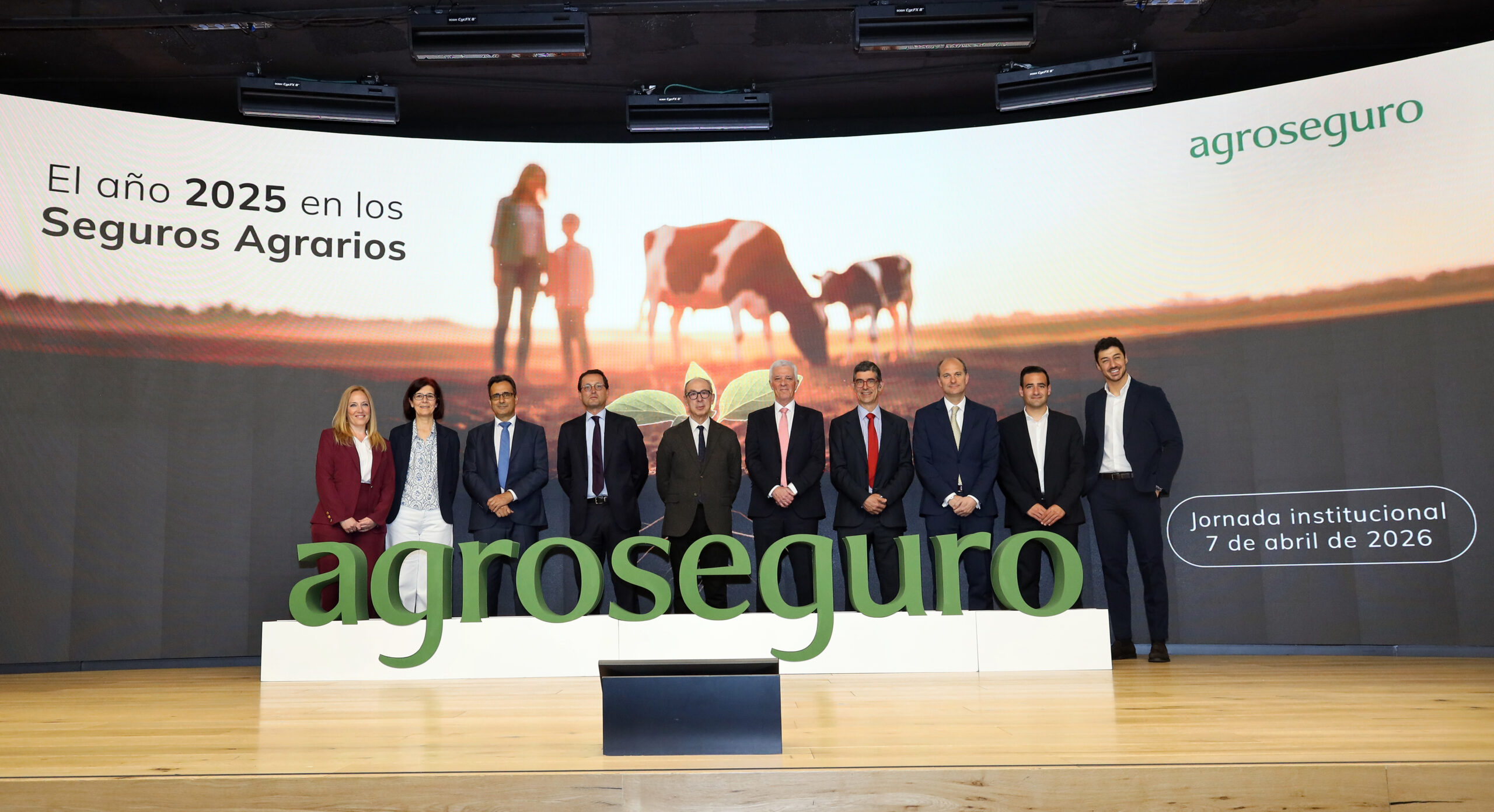
Madrid, 8 April 2026. Following the approval of the 2025 Annual Accounts and Management Report by the General Shareholders' Meeting on 26 March, Agroseguro held an institutional briefing yesterday, 7 April, to present the agricultural insurance figures for the recently concluded year.
Ignacio Machetti, president of Agroseguro, opened the session by welcoming attendees and highlighting the strong underwriting performance achieved in 2025. Written premiums totalled €1,029 million, a 0.92% year-on-year increase. This marks seven consecutive years of growth for the Spanish agricultural insurance system, with the last three years consistently exceeding the €1,000 million threshold. “The growth in last year’s underwriting was reflected across all indicators,” Machetti noted. “We saw a rise in the number of policies and, most significantly, in insured acreage, production volume, and sum insured. The latter reached a record €19,332 million – a 6.38% increase over the previous year – indicating a lower average global premium rate than in past periods.”
Claims, meanwhile, totalled €804 million, up 15% from 2024. This represents the second-highest nominal loss ratio in the history of Spanish agricultural insurance – despite the record level of coverage. It was surpassed only in 2023, due to the exceptional drought, which pushed claims to €1,241 million. Hail was unequivocally the primary driver of claims in 2025, with payouts exceeding €455 million. When combined with other storm-related risks such as heavy rainfall and flooding, the total surpassed €500 million – a historic high for these types of weather events. Fortunately, the year saw no significant damage from frost or drought. “Given these figures, the overall loss ratio for the year stood at 98.3%, which is very close to break-even”, Machetti stated.
Fruit and arable crops were the hardest hit by the year's weather events, with indemnities reaching €165 million and €129 million, respectively. Notable losses were also recorded in citrus fruits (€86 million), vegetables (some €73 million), and vineyards (roughly €73 million).
Miguel Pérez Cimas, director of ENESA (Spanish Agricultural Insurance System), subsequently detailed the evolution of the Ministry of Agriculture, Fisheries and Food’s budget for premium subsidies. Under the 2025 Plan, the budget “has reached its highest-ever allocation at €315 million,” supplemented by additional funding approved in recent years to support the real growth in insurance uptake. He emphasised that between ENESA and regional government grants, “nearly 50% of agricultural insurance premiums are now subsidised”.
José Antonio Hurtado, deputy director of Agricultural Insurance at Spain’s Insurance Compensation Consortium, explained the reinsurance mechanisms and their application across various insurance groups during high-loss years. He highlighted the current status of the stabilisation reserve, which “following the severe impact of 2023 and two consecutive years of positive reinsurance results, is now approaching €500 million”. Nevertheless, he cautioned that climate patterns are becoming increasingly severe. “This compels us to keep working toward the sustainability and viability of the agricultural insurance system, as it remains an indispensable tool for risk management,” he said.
Jaime Haddad, director of SAECA, outlined the benefits of the premium payment instalment plan backed by his company’s guarantee – a system now in its tenth year. “Nearly 200,000 policies can benefit from this option annually”, he noted, adding that recent management improvements have made the process even more accessible for farmers and livestock breeders.
The event also featured Francisco Cacho, physicist and renowned meteorologist for La Sexta, who delivered a presentation on climate change, its drivers, and its impact on agricultural production.
Finally, Sergio de Andrés, managing director of Agroseguro, presented the key projects implemented under the 2024–2026 Strategic Plan. De Andrés focused on the rigorous technical work of recent years, “which has enabled us to correct imbalances across almost all insurance lines”. He also detailed several innovation projects that have been prioritised in recent years, all aimed at optimising workflows and enhancing service quality. These initiatives have, among other achievements, made it possible to reach and maintain indemnity payment timelines significantly below the 30-day mark following the final loss adjustment. “There is no doubt,” he added, “that these advances are the driving force behind the positive results seen in the satisfaction surveys we conduct annually through an independent third-party firm.” He also took the opportunity to highlight the management of the significant generational turnover currently underway at Agroseguro, as well as the focus the organisation has placed on communication and corporate identity the last few years, which, as he noted, “were recently overhauled”.
The closing remarks were delivered by Ernesto Abati García-Manso, undersecretary of Agriculture, Fisheries and Food and chairman of ENESA. He underscored the “particular importance of agricultural insurance for the sector, as it is one of the primary safeguards for farm income and a fundamental tool for the sustainability of agricultural holdings”. He also praised the “exceptional performance of the public-private partnership that characterises the agricultural insurance system in our country”. Reflecting on recent major weather events, he noted that “we do not know when, but they will happen again”. Consequently, he reaffirmed that the government will remain steadfast in its support for agricultural insurance uptake, allocating a budget of €315 million for the 2026 Plan.